News
Evolving Collections, One AI Step at a Time
How The Auto Cave Uses BlytzCollect™ To Reduce Costs and Improve Collections
AI-powered collections is transforming how independent dealerships and auto lenders reduce delinquency and protect portfolio health.
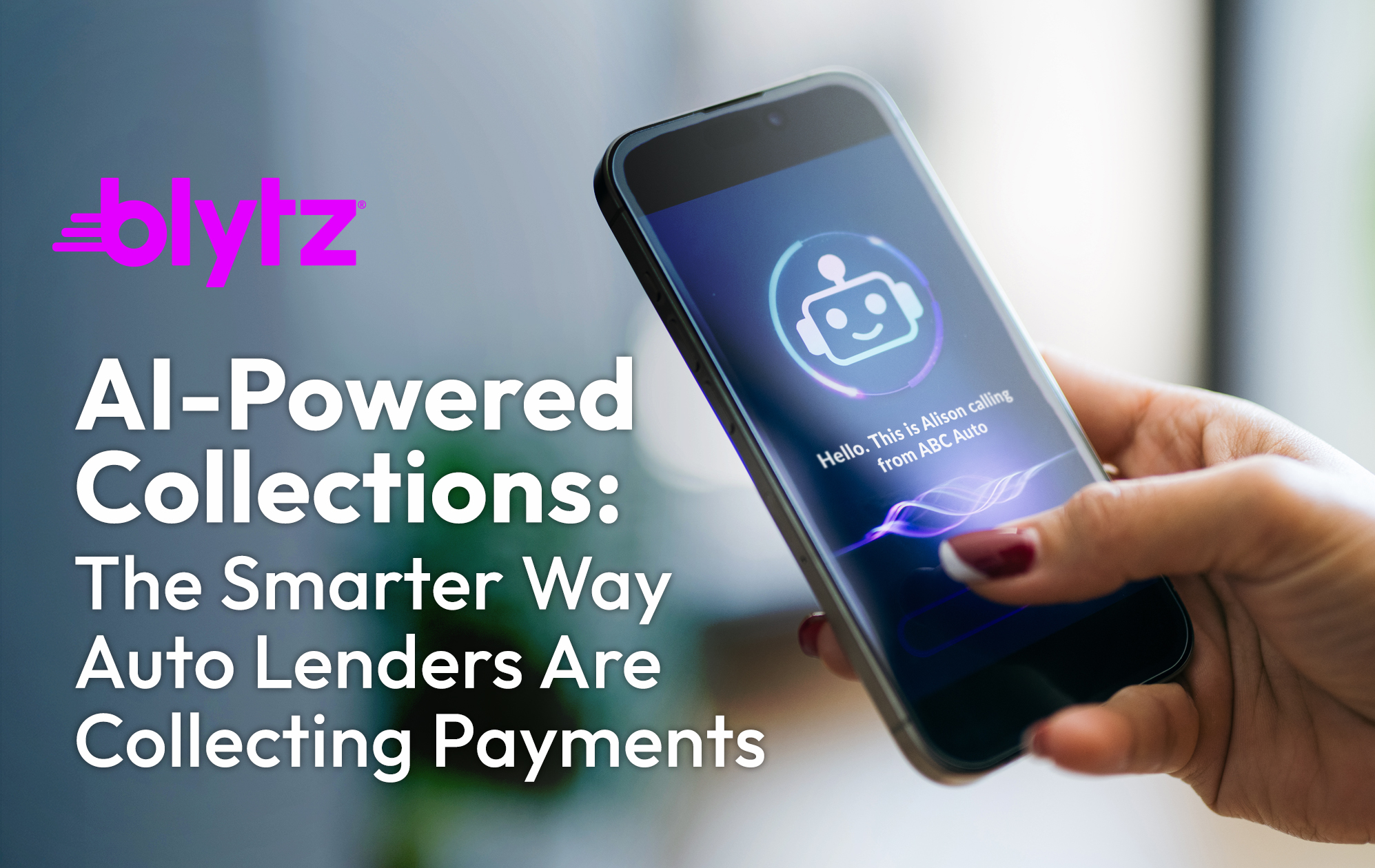
Auto lending has always carried repayment risk. But the tools lenders rely on to manage that risk haven't kept pace with borrower expectations or market realities. Blytz’s AI-powered collections is changing that and transforming how independent dealerships and auto lenders reduce delinquency and protect portfolio health.
Auto lenders and dealerships know the pattern well. A borrower misses a payment. An agent dials. A voicemail goes unreturned. A letter gets ignored. Meanwhile, the account ages, the likelihood of payment drops, and the cost of chasing that payment climbs.
It's a familiar cycle, and for most lenders it's still being managed with the same tools that existed 10 years ago: manual outreach, static payment reminders, and collection workflows that treat every borrower the same regardless of their history, preferences, or circumstances.
In auto lending specifically, where loan volumes are high, margins are tight, and delinquency rates have been rising steadily, the CFPB reported that serious auto loan delinquencies reached a 30-year high in 2024. Operational efficiency in repayment isn't just a nice-to-have; it's a competitive necessity.
The fundamental shift AI brings to auto lending isn't just automation, it's intelligence. There's an important distinction between the two. AI-powered collections use artificial intelligence to guide how and when lenders engage borrowers.
Traditional automation in collections means scheduled email blasts, phone calls, and templated letters. These tools are slow and they don't adapt. They treat a first-time borrower who missed a payment due to a bank error the same as a chronic delinquent with six missed payments.
AI-powered debt repayment tools, by contrast, can analyze borrower behavior, historical payment data, and communication preferences to determine the most effective outreach before an account ever becomes a problem. In practice, this shows up as:
The result is a repayment experience that feels less adversarial and more like a useful service, which matters enormously in an industry where the customer relationship doesn't end at the point of sale.
We are at the forefront of AI-powered collections with our BlytzCollect™ solution. BlytzCollect combines conversational AI with intelligent automation to help redefine what it means to get paid.
Effective AI-powered repayment in auto lending isn't a single feature. It's a coordinated strategy built on four interconnected capabilities:
1. Conversational AI
Modern AI agents can conduct natural, two-way conversations with borrowers — via text or voice — to resolve payment issues, answer questions about their account, process disputes, and guide them through payment without requiring a human agent to be involved. Borrowers increasingly prefer self-service options when the experience is intuitive, and conversational AI delivers exactly that.
2. Predictive Insights
Not every delinquent account carries the same recovery probability. Leveraging borrower profiles and behavioral signals, AI can help determine the best time for outreach based on the customers likelihood to pay. This allows human agents to focus their time on high-risk or high-value accounts where personal intervention actually moves the needle.
3. Multichannel Integration
A borrower might receive a reminder via an AI voice call, receive a follow-up text and complete payment through a secure text link — all as part of a single, unified interaction. When every channel is connected, data flows seamlessly, conversations don't restart, and borrowers aren't passed from system to system. That continuity is critical in auto lending, where trust in the lender directly impacts repayment behavior.
4. Personalization at Scale
Borrower demographics in auto lending vary widely. A first-time buyer financing a used sedan has a different profile and different communication needs than a repeat buyer who always pays on-time. AI enables lenders to tailor outreach frequency, messaging style, and escalation paths for each borrower, dramatically improving engagement rates across the full portfolio.
The business case for AI-powered repayment is no longer theoretical. Auto lenders deploying these tools are reporting measurable, recurring improvements:
BlytzCollect, part of the broader Blytz® ecosystem, is purpose-built for the repayment challenges auto lenders and dealerships face. It combines conversational AI with intelligent automation to streamline collections — conduct outreach faster faster, and with less friction for both the lender and the borrower.
Conversational AI for Voice
BlytzCollect handles outbound borrower interactions naturally with seamless communication that is both intuitive and conversational. The system understands intent, navigates questions, and guides borrowers through resolution, and when required, can forward customers to a live agent for complex needs.
Embedded Secure Payment
Rather than directing borrowers to a separate portal, BlytzCollect delivers a secure payment link via text message immediately after the conversation. Making it easy to make a payment and reducing steps between engagement and payment directly improves conversion.
Native DMS Integration
As part of the Blytz ecosystem, BlytzCollect integrates directly with your dealer management system, eliminating duplicate data entry and ensuring that every interaction is automatically logged and synchronized for compliance and auditing.
Multilingual Support
Auto lending portfolios are diverse. BlytzCollect supports multiple languages, allowing every borrower to interact in their preferred language; an increasingly important capability in markets where English is not the borrower's first language.
AI as a Force Multiplier, Not a Replacement
The most effective auto lenders deploying AI aren't eliminating their collections teams. They're making them dramatically more productive. BlytzCollect handles the high-volume, routine interactions that previously consumed collections agents' time, freeing human staff to manage complex accounts, negotiate arrangements, and maintain the borrower relationships that protect long-term portfolio performance.
Think of it the way a well-run service department thinks about diagnostic technology: it doesn't replace the technician, it ensures the technician's time is spent on work only they can do.
Auto lending has always been a margin-sensitive, relationship-dependent business. Lenders who continue relying on legacy repayment infrastructure are carrying unnecessary cost, accepting lower recovery rates, and creating borrower friction that damages the long-term customer relationship.
BlytzCollect offers a better model. One built for the realities of modern auto lending, where borrowers expect to be reached on their terms, repayment should be frictionless, and every percentage point of recovery improvement goes directly to the bottom line.
The future of auto loan repayment is here. To learn more about BlytzCollect and the Blytz platform, connect with our team for a tailored demonstration.
Is AI-powered repayment outreach compliant? Yes, when deployed correctly. AI-driven borrower communication is subject to the same regulatory framework as human-led outreach, including FDCPA, TCPA, and applicable state-level lending regulations. BlytzCollect is built with compliance as a core requirement with full audit trails and configurable rules to keep every interaction within regulatory boundaries.
Can AI handle complex borrower questions and payment disputes? Modern conversational AI, powered by advanced natural language processing, is capable of understanding borrower intent, not just keywords. BlytzCollect can navigate account inquiries, address payment questions, and guide borrowers through resolution without escalating to a human agent in the majority of cases. When escalation is warranted, the AI Agent can transfer the call to a live agent and the full AI conversation history is tracked seamlessly.
Why does multichannel integration matter in auto loan repayment? Borrowers don't experience your repayment process as a series of separate channels. They experience it as a single relationship with their lender. Multichannel integration ensures that a text conversation, a voice interaction, and a payment link are all part of one continuous thread. It eliminates the frustration of borrowers having to repeat themselves, and gives your team a complete, real-time picture of every account.
Will borrowers actually engage with AI voice interactions? For the answered calls, yes, the data supports this. AI voices are intended to be conversational in tone, pacing, and inflection. More importantly, borrowers engaging with AI voice tools through BlytzCollect aren't evaluating whether the voice is human, they're evaluating whether the interaction is effective, easy and respectful. When it is, engagement and repayment rates follow.
How The Auto Cave Uses BlytzCollect™ To Reduce Costs and Improve Collections
Expanded platform combines payments, AI-powered outreach, and intelligent automation to turn collections into a predictable revenue engine.
What Dealers Need to Know About Automated, AI-Driven Payments